

On 13 November, Microsoft 365 began failing across 74 countries. Outlook went dark, teams went patchy, Copilot dropped out. For more than 11 hours, some of the most widely used workplace tools in the world were unavailable or unreliable, with no clear cause and no confirmed timeline for recovery.
For businesses that had built their entire daily operation around these tools, it was a complete shutdown.
I happened to be on leave that day but the question it raised was: how prepared are most teams to function when the platforms they rely on simply stop working?
The Single Point of Failure Problem
The Microsoft outage was not the first of its kind and will not be the last. In July 2024, a faulty CrowdStrike update took down 8.5 million Windows devices globally. Before that, there was the AWS outage of 2021 that brought down large portions of the internet for hours. These events are not anomalies. They are the predictable cost of deep dependency on a small number of centralised platforms.
Most organisations have business continuity plans for physical disasters: fire, flood, power failure. Far fewer have thought seriously about what happens when the digital infrastructure that runs their meetings, their communications, and their documents becomes unavailable for half a day.
When a Crisis Becomes a Creative Brief
While IT teams scrambled, some brands turned the outage into a creative opportunity within hours.
IKEA Singapore posted its jerboa soft toy on Instagram with one line: “Thank god there’s no outage on this micro-soft.” It got nearly 22,000 likes.

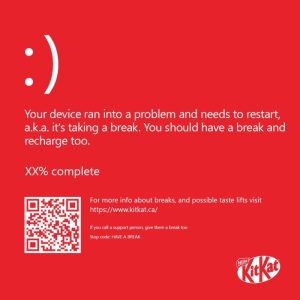
KitKat tied its “Have a break” tagline directly to the crashed Outlook screen.
Yahoo posted a simple text-only Instagram reminding people their personal email was just fine and picked up over 100,000 likes.
None of these campaigns required a planning meeting, a slide deck, or a Microsoft 365 subscription. They required a team that was paying attention, could make a quick decision, and had the creative confidence to act on it.
That kind of agility comes from a culture where people are trusted to respond creatively, quickly, and without waiting for the tools to be perfect.
What Creative Leadership Looks Like in a Crisis
The teams that navigated the outage best were not necessarily the ones with the most sophisticated backup systems. They were the ones whose members knew how to work without waiting for a tool to tell them what to do next.
This is a creative leadership question as much as a technical one. When the presentation software is down, can your team still run a meeting? When email is unavailable, do people know who to call and what to say? When the shared drive is inaccessible, is there enough shared context in the room for work to continue?
Creativity under constraint is a skill that has to be practised. Teams that only ever work inside a single ecosystem become dependent on its availability. Teams that have occasionally been asked to work differently — to present without slides, to plan without templates, to communicate without digital tools — develop a flexibility that serves them well when the unexpected happens.
An Unexpected Opportunity
There is another way to look at this. For organisations with the appetite for it, a planned technology-free day is one of the most underused creative interventions available.
A day where the team gathers in person, with paper and pens and conversation, to think about future projects, emerging challenges, and strategic questions that rarely get the uninterrupted attention they deserve. No notifications. No context-switching. No slide decks to hide behind.
The absence of tools creates the conditions for a different kind of thinking: slower, more collaborative, more likely to surface the ideas that get crowded out by the daily operational noise.
Some of the most innovative companies in the world already build protected time for unstructured thinking into their calendars deliberately. The Microsoft outage, for the teams it caught, was an accidental version of this. The question is whether your organisation waits for the next outage to discover what your team is capable of without the tools, or whether you create the conditions to find out on your own terms.
Three Questions Worth Asking
Can your team run a full working day if Microsoft 365, Google Workspace, or your primary communication platform goes down tomorrow?
When did you last ask your people to solve a problem without the usual tools?
What would your team produce if you gave them a day, a room, and no screens?