
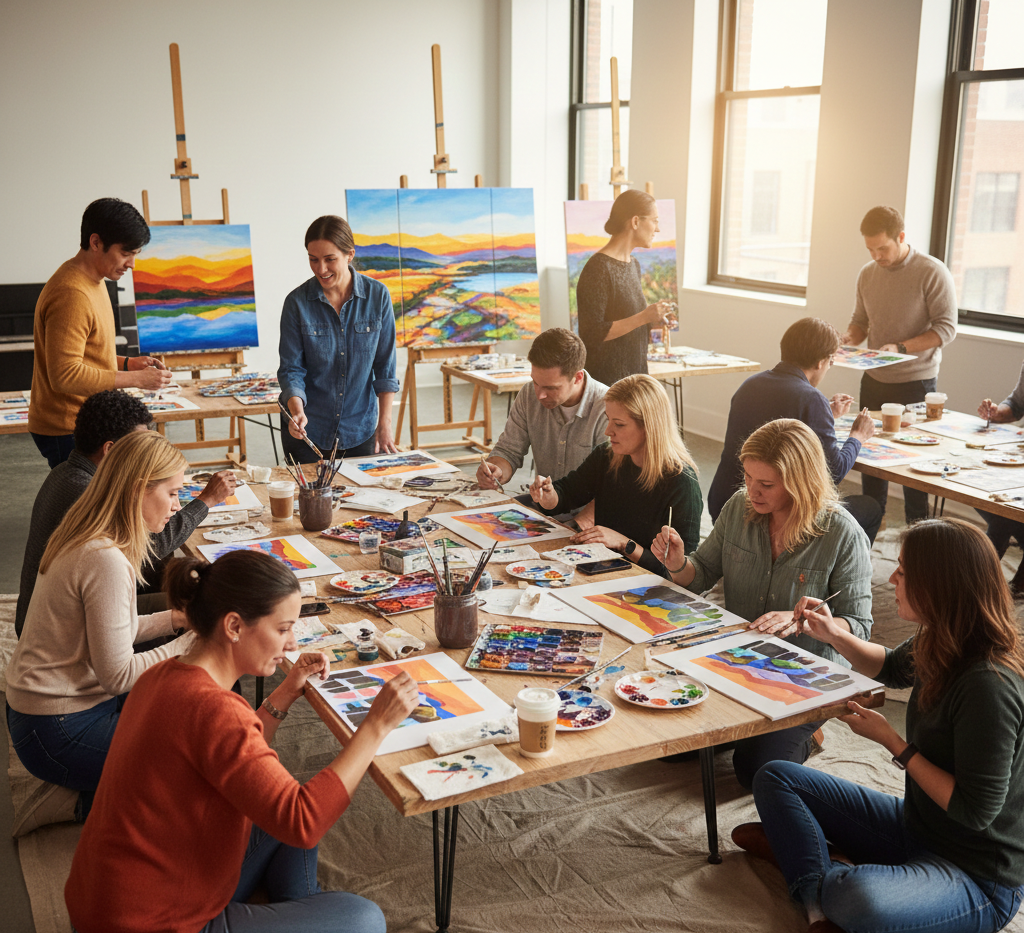
Why collaborative creativity can reduce burnout and what leaders can do about it.
Organisations often approach burnout as an individual problem, encouraging employees to take breaks, attend wellness sessions, or develop personal resilience.
Yet emerging research in organisational psychology points in a different direction. Studies examining team creativity, the process of groups generating ideas, solving problems collaboratively, and experimenting together, suggest that creativity within teams is associated with higher job satisfaction and lower burnout levels.
The reason is not simply that creativity feels enjoyable. It changes how people experience work.
Creativity Shifts Work From Pressure to Possibility
When teams operate purely in execution mode, work can become narrow and repetitive. Decision-making becomes risk-averse, communication becomes transactional, and individuals often feel isolated in their responsibilities.
Creative collaboration introduces a different dynamic.
Teams engaged in creative processes tend to:
-
exchange perspectives more openly
-
experiment with ideas without immediate evaluation
-
build solutions together rather than defend individual positions
These behaviours strengthen psychological safety, one of the most reliable predictors of team learning and performance.
Just as importantly, creative work activates curiosity and exploration, emotional states that counterbalance stress and cognitive fatigue.
In this sense, creativity functions less as a luxury and more as a protective factor against burnout.
Why Teams Need Creative Spaces
Burnout rarely arises from workload alone. More often, it develops when work becomes predictable but emotionally draining, with little room for expression or agency.
Collaborative creativity helps address this by restoring three elements often missing in high-pressure environments:
1. Autonomy
Creative exercises allow individuals to contribute ideas and perspectives in ways that feel personal and meaningful.
2. Connection
Building something together shifts interactions from task management to shared exploration.
3. Perspective
Creative processes help teams step back from operational pressure and see problems from new angles.
Together, these experiences can renew motivation and restore energy within teams.
The Role of Arts-Based Interventions
Alongside research on team creativity, another body of evidence continues to grow: arts-based interventions are increasingly recognised for their therapeutic and reflective value.
Art-making, whether through drawing, collage, storytelling, or visual metaphor, helps participants express experiences that may be difficult to articulate in purely analytical discussions.
Unlike traditional problem-solving conversations, arts-based approaches allow teams to explore emotional and relational dynamics in a non-threatening way.
Participants often discover that creative expression:
-
surfaces unspoken challenges
-
reveals how team members perceive shared experiences
-
encourages empathy and deeper listening
These processes strengthen interpersonal understanding and contribute to a healthier team climate.
In organisational contexts, the goal is not artistic mastery. It is insight.
When facilitated thoughtfully, creative expression becomes a tool for reflection, connection, and learning.
Creativity as a Cultural Signal
Perhaps the most important implication is cultural.
When organisations intentionally create space for creativity, they send a signal that exploration, experimentation, and human expression are valued.
This signal matters because teams often take behavioural cues from what leaders allow or discourage.
Creative team activities can therefore do more than boost morale in the moment. They can help establish norms around:
-
openness
-
curiosity
-
shared problem-solving
-
emotional awareness
Over time, these norms strengthen resilience and reduce the conditions that lead to burnout.
Practical Activities & Facilitation Ideas
Below are three activities that translate these insights into team experiences.
1. Collaborative Creative Challenge
Objective:
Strengthen collaboration and perspective-taking through shared creative problem-solving.
How it works:
-
Divide participants into small teams.
-
Provide a challenge such as designing a visual representation of the team’s future vision or building a symbolic structure using limited materials.
-
Introduce constraints midway (e.g., new goals or resources removed) to encourage adaptation.
Facilitation focus:
Encourage reflection on how the team communicated, shared ideas, and navigated uncertainty.
2. Artistic Reflection Session
Objective:
Encourage deeper reflection on team dynamics.
How it works:
-
Ask participants to create a simple drawing or collage that represents their experience of working in the team.
-
Participants explain their artwork in small groups.
-
Facilitate a conversation about common themes and insights.
Facilitation focus:
Emphasise interpretation and storytelling rather than artistic ability.
3. Visual Metaphor Workshop
Objective:
Help teams articulate challenges and opportunities creatively.
How it works:
-
Provide magazines, markers, and art materials.
-
Ask teams to create a visual metaphor representing a current challenge or goal.
-
Each group presents their metaphor and explains the thinking behind it.
Facilitation focus:
Guide the discussion toward insights about collaboration, communication, and shared goals.
A Final Thought
Creative experiences do more than energise a team for a day. They allow people to reconnect with curiosity, expression, and collaboration, the very qualities that sustain healthy teams over time.
In an era where burnout is increasingly common, organisations may find that the path to resilience is not always through efficiency.
Sometimes it begins with creativity.