
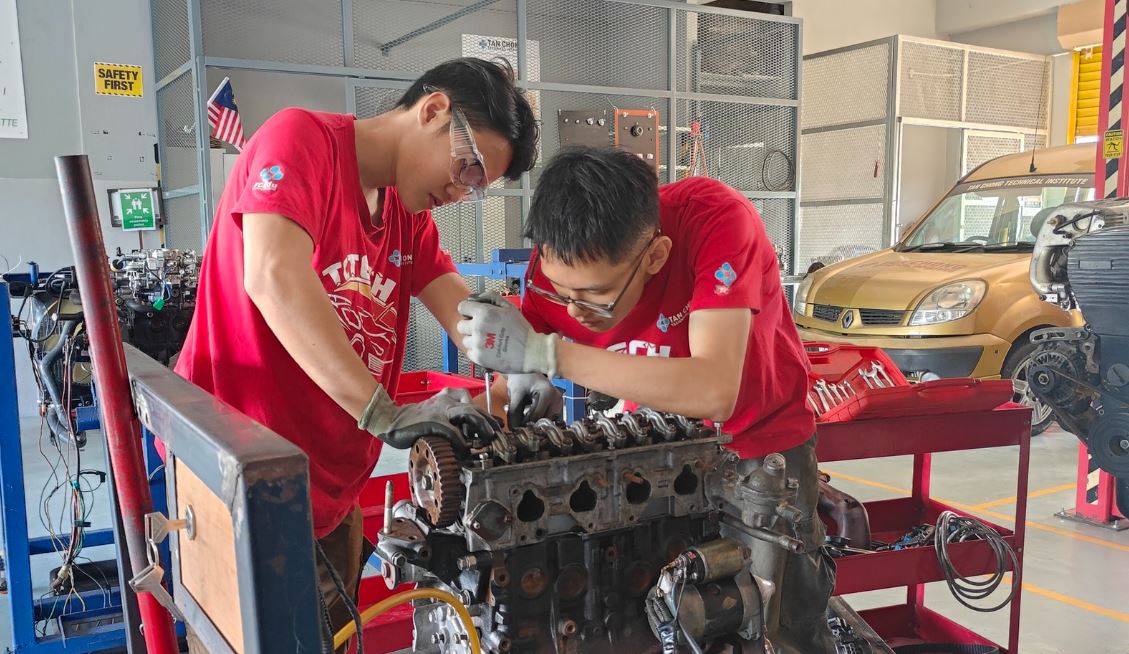
Tan Chong Motor Holdings has been quietly changing lives for decades. Not through year-end donations or glossy CSR pages but through something more deliberate: a community investment philosophy that builds capability, creates pathways, and compounds across generations.
Founded in 1972 and best known as the assembler and distributor of Nissan vehicles in Malaysia, Tan Chong’s story beneath the showrooms is one that more Malaysian companies should know and learn from.
Building people, not just cars
The clearest expression of Tan Chong’s approach is TC Tech, the Tan Chong Technical Institute, the group’s own vocational education arm. Established to provide technical and vocational education and training in the automotive sector, TC Tech was designed specifically for school leavers, with a particular focus on young people from B40 families who might otherwise find themselves without a clear pathway into skilled employment.
This is not a scholarship programme that funds bright students at established universities. It is something more deliberate, a decision to build the pipeline that Malaysia’s automotive workforce needs, from the ground up, using the company’s own resources, expertise, and industry relationships.
What makes TC Tech genuinely distinctive is what comes after the training. Tan Chong offers scholarship support and direct job opportunities to graduates of its own TVET programmes, creating a closed loop from education to employment that most companies never attempt. The young person who walks into TC Tech as a school leaver can walk out as a skilled technician with a job already waiting.
That is investment in human capital and it happens to serve both the community and the business at the same time.
Looking after the whole person
Tan Chong’s community commitment extends beyond the workshop floor. The group runs a Childcare Centre Programme that provides academic support, mental enrichment, and physical activities for children of single-parent and B40 families.
During the COVID-19 pandemic, employees of Edaran Tan Chong Motor contributed directly to food security efforts in communities like Rawang, supplemented by the company loaning vehicles for distribution support.
These initiatives reflect a company that understands its presence in a community as something more than a commercial transaction.
The Sabah chapter
Perhaps the most ambitious expression of Tan Chong’s community investment thinking is its long-term commitment to Sabah. When the group announced plans to establish automotive assembly operations in the state, it did so with an explicit commitment to skills transfer, setting up a training centre in Sandakan ahead of the assembly plant itself. The intention was clear: before we bring the jobs, we prepare the people.
This sequencing matters. It is the difference between a company that extracts value from a community and one that invests in it before asking anything in return.
What Malaysian companies can learn
Tan Chong’s approach contains three lessons that are directly applicable to any Malaysian company thinking seriously about community investment and cause marketing.
The first is that the most powerful community investment is connected to what you actually know how to do.
Tan Chong didn’t build a hospital or fund an arts programme. They built a technical institute because that is where their expertise lies, where their industry relationships are deepest, and where their contribution would be most genuine.
Community investment that is disconnected from a company’s core capability tends to feel performative. Investment that flows from that capability tends to feel true.
The second is that the pipeline matters more than the gesture. A single donation event changes very little. A sustained commitment to building capability — in communities, in young people, in the workforce — compounds over time in ways that both the community and the company feel.
Tan Chong has been running TC Tech since the early days of the group. The returns on that investment, in skilled workforce, in community goodwill, and in brand equity, are not measurable in a single annual report. They accumulate across decades.
The third is that cause marketing is most credible when the cause is already lived. Tan Chong doesn’t need to tell a story about community investment. It is doing it, consistently, at scale, in ways that are verifiable and visible. That is the foundation on which any cause marketing strategy should be built, not a campaign that precedes action, but a story that follows it.
The quiet confidence of doing it right
There is something almost un-Malaysian about Tan Chong’s approach to community investment, in the best possible sense. In a business culture that sometimes mistakes visibility for impact, Tan Chong has been doing the work quietly and consistently for decades. The institute. The childcare centre. The training centres that precede the factories.
For Malaysian companies that want to move from writing cheques to building something real, Tan Chong is a masterclass in what community investment looks like when it is genuinely integrated into how a business operates, not bolted on at the end of the financial year.
That is what cause marketing consulting exists to help companies find: the place where what you do best and what your community needs most actually overlap.
When you find that place, you don’t need to manufacture a story. You already have one.