
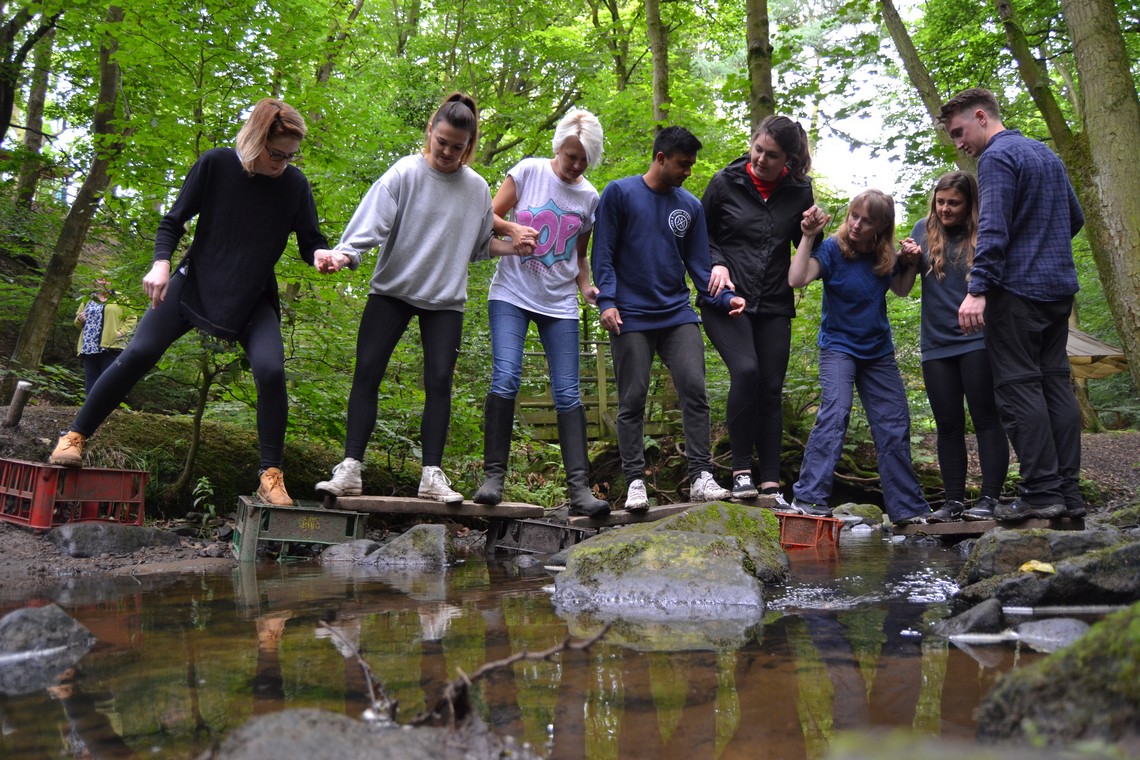
There is a moment in almost every well-designed team experience when something shifts. The room loosens. People stop performing and start participating. Laughter appears. The kind that happens when something genuinely surprises you. Energy builds without anyone forcing it.
And then, if the programme is designed well, that energy doesn’t dissipate when the activity ends. It carries forward into the debrief, into the conversation over lunch, into the way people interact with each other the following week.
That shift has a name in psychology. It’s called flow. Understanding it changes everything about how you design experiences for teams.
What flow actually is
Hungarian-American psychologist Mihaly Csikszentmihalyi spent decades studying what he called “optimal experience”. The state in which people are so fully absorbed in what they’re doing that time seems to change, self-consciousness drops away, and performance rises naturally. He called this state flow.
The conditions that produce flow are precise. The challenge of the activity needs to match the skill level of the person doing it. Too easy and people disengage driting into boredom. Too difficult and they become anxious, self-protective, and closed. But when the challenge is calibrated just right, stretching people without overwhelming them, people become genuinely present. They stop watching themselves and start doing.
Flow is not a mystical state reserved for athletes or artists. It is a predictable psychological response to the right conditions. The good news is that it is entirely designable.
The problem with separating fun from performance
Many team programmes are built on a false distinction: there are the fun parts and there are the learning parts. The icebreaker, then the serious workshop. The game, then the debrief where we extract the lesson. The social dinner, then the strategy session.
This separation is understandable and usually comes from good intentions. People want their teams to enjoy themselves. Nobody wants to sit through a dry, joyless training day. However, the separation also creates a problem: it signals to participants that engagement and performance are different things. That you switch off one to access the other.
Csikszentmihalyi’s research suggests the opposite is true. The conditions that produce enjoyment and the conditions that produce performance are, at their core, the same conditions. Clear goals. Matched challenge and skill. Immediate feedback. A sense of control. When these are present, people don’t just have fun, they learn faster, connect more genuinely, and carry more away.
The best team experiences don’t separate fun from performance. They integrate them so that participants can’t quite tell where one ends and the other begins.
Bringing out the adult and the child at the same time
There is a version of team building that mistakes childishness for playfulness. Activities that feel infantilising, that ask professional adults to do things they would never choose to do on a normal working day. Typically activities that generate embarrassment more than engagement.
Good facilitation understands that play is not age-specific. It is a state of engagement – curious, energised, present, willing. Adults enter that state just as readily as children do, but the conditions have to be right. The activity has to feel meaningful, not arbitrary. The challenge has to feel real, not manufactured. And participants have to feel respected throughout, especially those who are less comfortable with public vulnerability or physical activity.
The goal is not to make adults act like children. The goal is to access the quality of attention that children bring to things that genuinely engage them and to design activities that earn that quality of attention from a room full of experienced professionals.
That requires a different kind of facilitation. Less entertainment, more engineering.
The facilitator’s most important job
Here is something that separates good team building facilitation from excellent facilitation: the willingness to explain why.
Most facilitators run activities. Excellent facilitators explain the behavioural logic behind them not in a way that kills the experience by spewing jargon and science terms, but in a way that gives participants a framework for what they’re about to do and why it matters. When people understand the purpose of an activity, they engage with it differently. They bring more of themselves to it. They notice more. They take more away.
This is about respecting the intelligence of the people in the room. Professional adults engage more deeply when they understand the design intention, when someone says, “we’re doing this because research shows that when challenge and skill are matched, people enter a state of genuine focus and connection, and we want you to experience that today.”
That sentence changes the activity. Not the activity itself, the meaning people bring to it.
What integrated wellbeing and performance design actually looks like
A programme designed around flow principles looks different from a conventional team day in a few specific ways.
The activities are sequenced deliberately, starting at a level that builds confidence, then increasing in complexity and relational demand as the group warms up. This mirrors the flow model exactly: you don’t pitch the challenge at maximum difficulty from the start. You let skill and confidence build, then raise the stakes.
The debrief is not separate from the activity, it is woven into it. Feedback is immediate, specific, and connected to what participants just experienced in their bodies and their interactions, not extracted from it after the fact.
The energy of the group is treated as a resource to be managed, not a byproduct to be enjoyed. Facilitators track energy levels when the room is peaking, when it’s flagging, when people need challenge and when they need recovery, and adjust in real time.
Participants leave not just with good memories, but with a felt experience of what it is like to work well together- which is, ultimately, what every organisation that commissions a team experience is actually asking for.
The bottom line
Flow is not a nice-to-have in team programme design. It is the mechanism through which engagement, connection, and performance happen simultaneously. When the conditions are right, people don’t experience wellbeing and output as separate things. They experience them as the same thing.
That integration of energy, connection, and output is what distinguishes a team experience that people remember from one they’ve forgotten by the next Monday.