
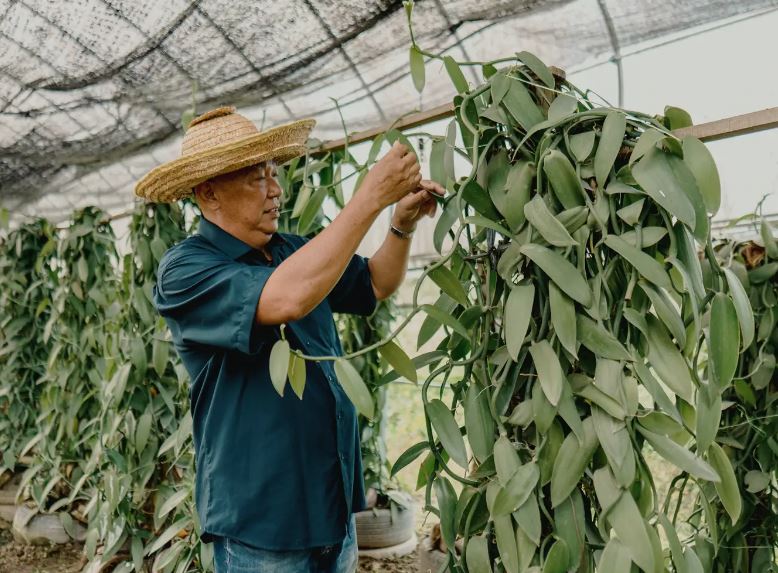
Alfred Phua never planned to become a farmer.
For 35 years he was a social worker, the kind of person who shows up in the difficult places that most professionals prefer to read about rather than enter. Over time, his NGO work led him toward agriculture: natural farming, mushroom growing, vermicompost. And eventually, vanilla.
Today, Uncle Alfred, as everyone calls him, runs Vanilla Impact Story (VIS) in Sibu, Sarawak. He grows one of the world’s most expensive spices on a farm staffed primarily by former convicts. Vanilla, the second most expensive spice after saffron, reached prices above USD 600 per kg in 2019.
In 2023, global vanilla trade reached USD 610 million. Malaysia’s share: USD 22,600 — 69th out of 122 exporting countries worldwide.
Uncle Alfred is not primarily trying to capture that market. He is trying to do something more specific and more difficult: prove that people, like vanilla, bloom in their own time, if you’re patient enough to wait.
The plant that punishes impatience
Vanilla is notoriously difficult to grow. It takes years for a vine to flower, and when it does, there is only a four-hour window to hand pollinate each bloom. There is no shortcut. No technology that accelerates the process. Just patience, attention, and the willingness to show up on the right day.
“I cannot hasten the process as I want to make it as environmentally-friendly and natural as possible,” Uncle Alfred says. The farm operates at the pace the plant demands.
The same philosophy applies to his hiring model. VIS employs local community members and former convicts, people for whom the conventional job market offers thin opportunities and thinner dignity. Workers receive a basic pay of RM1,700, lodging, and a promise of profit-sharing upon a successful harvest.
“I strongly believe in sustainability. We not only provide shelter and ration, they need income; more importantly they need to earn the ability to stand on their own two feet with dignity,” Uncle Alfred says.
Henry Wong is one of them. He came from restaurant kitchens and boat crews, knowing nothing about vanilla. He failed his first hand pollination attempt. The second round was 30% successful. The third, 70%. Uncle Alfred tells the story with a laugh. There is no drama in it. Just the ordinary shape of someone learning something hard, slowly, with support.
This is what community investment looks like when it is working. Not a photo opportunity. Not a cheque. A farm in Sarawak where former convicts are learning to pollinate vanilla by hand, earning a wage with profit-sharing on the horizon, and being given the time to get it wrong before getting it right.
Most Malaysian CSR is still just cheque-writing
Uncle Alfred’s story did not happen because a corporation decided to sponsor a cause. It happened because a foundation, Yayasan Hasanah, specifically, decided to back a business model and because someone was willing to build something patient in a culture that rewards speed.
This distinction matters enormously for how Malaysian companies think about CSR.
Since 2006, Bursa-listed companies have been required to disclose CSR activities. The result has been a sector optimised for disclosure rather than impact. The familiar photo: a ceremonial cheque, two rows of people smiling, a banner with logos. The money is real. The cause is real. But the relationship typically ends at the photo.
Research comparing Malaysian CSR practice with international counterparts consistently finds the same pattern: local practice is primarily centred around compliance and operational efficiency rather than the more integrated approach seen in markets where community investment is treated as genuinely strategic rather than reputationally defensive.
The problem with building your CSR strategy around disclosure requirements is structural: those requirements are designed to be achievable by everyone. They are the floor. When you optimise for the floor, you build nothing above it.
A sector growing slower than it should
Here is the part of the story that most Malaysian business leaders don’t know: there is an entire sector of businesses specifically built to solve the problems that CSR programmes claim to care about and most corporations are not working with them in any meaningful way.
Malaysia’s social enterprise ecosystem has been developing for over a decade, from MaGIC’s foundational work to the SEMy2030 strategic blueprint. The momentum was real five years ago. The progress since has been slower than anyone hoped.
The government set a target of 1,000 social enterprises by 2018 and 5,000 by 2025. As of late 2024, approximately 510 are accredited nationwide. Only 37% have achieved profitability. Seventy-one per cent started with the founder’s own savings.*
The sector isn’t struggling because the ideas are weak. It is struggling because it operates in a funding gap that corporations with their governance frameworks, procurement budgets, and long-term planning horizons are uniquely positioned to help close. Most haven’t.
The same companies keep appearing at the same events. The ecosystem needs new entrants, new capital, and new kinds of partnership from the private sector.
What Yayasan Hasanah shows is possible
Vanilla Impact Story exists in its current form because of the Hasanah Social Enterprise Fund (HSEF), an initiative by Yayasan Hasanah, the impact-based foundation of Khazanah Nasional Berhad, in collaboration with the Ministry of Finance. The fund’s support enabled VIS to build two greenhouses and purchase 1,500 cuttings of Planifolia and Tahitensis vanilla species.
Since its founding in 2015, Hasanah’s work has reached 3.7 million lives across education, community development, environment, arts, and public spaces. In 2024 alone, 814,563 people were reached.
The Hasanah model is instructive not because of the scale but because of the philosophy. Stanley Siva, Head of Social Enterprise at Yayasan Hasanah, explains: “Using a commercial model, it is able to deliver social and environmental impact in a more sustainable fashion. They are able to reinvest the surplus they make from their organisation back in the communities they are serving or problems they are trying to solve.”
This is the distinction that matters. A donation is spent once. A social enterprise investment builds something that continues to generate impact long after the initial capital is deployed. The vanilla farm in Sibu will employ former convicts next year, and the year after, and the year after that — not because it received a cheque, but because it built a business.
VIS has since expanded beyond its own farm: training 14 contract farmers across Sirian, Bau, Kuching, and Puncak Borneo, selling RM10,000 in cuttings, and building vanilla products like moisturiser and coffee in collaboration with farmers from Sabah and Johor. A buy-back arrangement guarantees market access for contract farmers at prevailing prices. What started as one social worker’s experiment has become a growing ecosystem.
Three questions for Malaysian business leaders
The gap between where CSR money currently goes and where it could go is not primarily a financial gap. It is a clarity gap. Most companies have not decided, at a foundational level, what they genuinely stand for. So they default to what is visible, safe, and photographable.
Before your next CSR budget cycle, three questions worth sitting with honestly:
Does the cause influence how we operate or only how we communicate? A company that funds a community programme while its own internal practices contradict that commitment is telling its employees something about its actual values, regardless of what the annual report says.
Are we measuring outcomes or activities? Counting cheques written, trees planted, and ringgit donated measures activity. Measuring whether the people you supported are better off twelve months later that measures impact. The two are not the same.
Would we do this if no one was watching? If the honest answer is no — if the programme exists primarily for the report — then it is a communication strategy, not a community commitment. There is nothing wrong with communication strategy. But calling it impact work misleads everyone, including the people you’re trying to help.
Uncle Alfred didn’t build Vanilla Impact Story because it would look good in a report. He built it because he had spent 35 years watching what happens to people when no one believes they’re worth investing in and decided to do something different.
That is what genuine cause commitment looks like. And the corporations willing to learn from it, back it, and build long-term partnerships with businesses like it are the ones that will mean something to their communities in ten years.
The rest will still be handing over a cheque.
*Statistics sourced from MaGIC (2021), Baskaran et al. (2019), MEDAC (2022), and The Edge Malaysia (December 2025)